Conference Strategy:
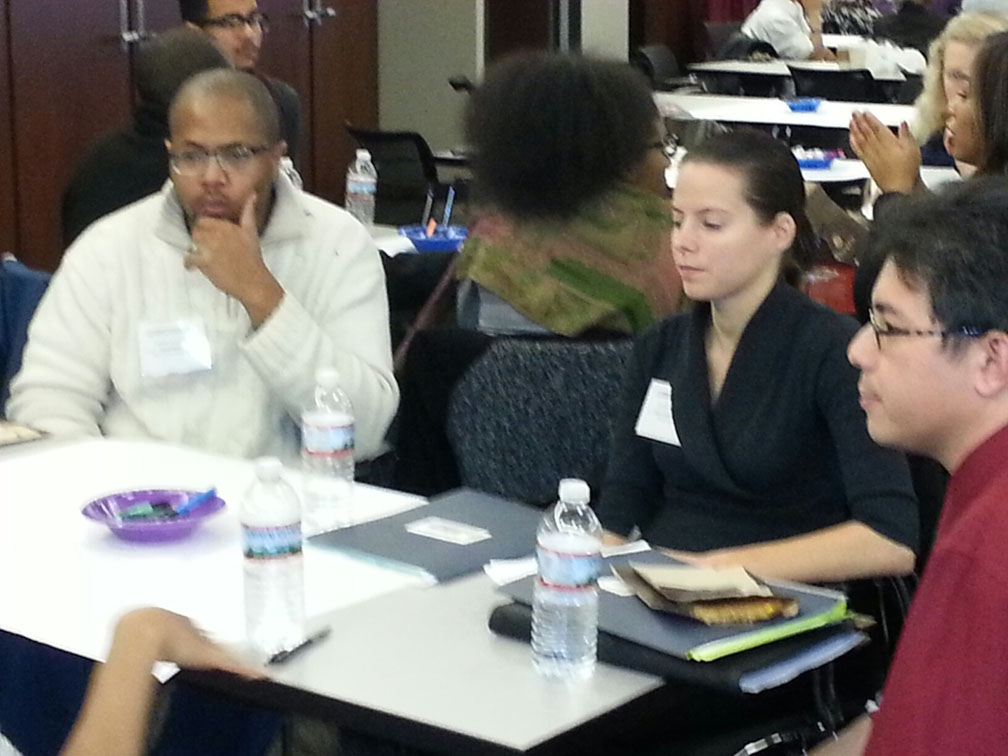
When leaders and volunteers connect, they
share ideas and help each other!
The 1994 to 2015 conferences were part of an ongoing strategy aimed at building connections between the people leading tutor/mentor programs, the people who are volunteers, and the people who provide the money so that high quality tutor/mentor programs can reach more K-12 youth in high poverty neighborhoods in Chicago and other cities.
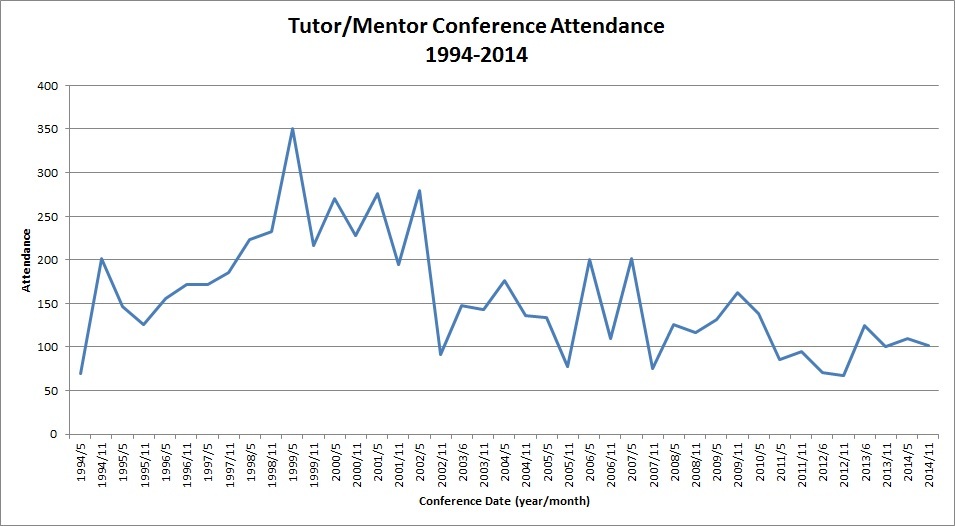
This chart shows conference participation from May 1994 to May 2015. This was done by students
participating in a 2015 Information Visualization MOOC hosted by Indiana
University. Mapping conference participation is critically important and we hope
other students will help us analyze participation in Tutor/Mentor Conference,
while helping us spread this idea to others who organize much larger events
focused on the same goals. Read
more.
A 2025 IVMOOC team from Indiana University created a new way to look at participation in these conferences. View the interactive Kumu.io map in this article. Watch for 2026 updates that show a tool any event organizer can use to create similar participation maps!
While each conference only brought a small number of people together (ranging from as low as 70 to as high as 300), the communications and networking before each conference was intended to draw the attention of thousands of people to information hosted on web sites and blogs that can be used to build a better understanding of where and why tutor/mentor programs are needed along with what business, faith groups, universities and people beyond the management team of a non profit can do to make high quality programs available in more places.
Goals:
-
Draw leaders, volunteers, and stakeholders from more than 150 agencies together for networking and information sharing. Read this PDF article to expand your network-building abilities.
-
Draw business and philanthropy partners into ongoing learning and partnership with tutor/mentor leaders
- Provide a vision for comprehensive, long-term mentoring that leads youth to careers
- Build trust and relationships among stakeholders to generate partnerships and information sharing during the months between each conference.
- Build awareness of online learning and networking resources and motivate a growing number of participants to use these tools for capacity improvement
Each conference offered workshops on planning, evaluation, recruitment, training, marketing, and other topics relevant to tutoring/mentoring youth at different ages.
The Conference as Part of a Larger Strategy:
In 1994 a survey was sent to leaders of volunteer-based tutor/mentor programs in the Chicago region, in an effort to build a master database that could be used in advertising and marketing efforts intended to draw needed resources to every program in the region. Two questions in the survey led to T/MC launching this conference. One asked "How much need would you say there is for increased contact between programs." A second asked "How likely is it that you would attend a city-wide conference? 68% were very likely to attend and 22% were somewhat likely to attend. So we launched the first conference in May 1994 and have hosted them every six months since then. See 1994 survey responses.
The May/June Conference was intended to
celebrate the work of youth and volunteers during the school year. It is also a time to share best practices, strengthen
next year’s programs, and raise public awareness about the need for renewed support
in the coming academic year. The work done in May can lead to more
successful volunteer-recruitment strategies in August and September and more
powerful resource-development strategies in November and December.
The November Conference took place shortly after the start of each
school
year when programs had recruited and placed students and volunteers.
The focus of this conference was on teaching volunteers to be more
effective tutors and mentors and fostering the leadership skills
necessary to help programs grow. Since this conference is just before the year end holidays, its goal is also to make potential donors more aware of tutor/mentor programs so that when they choose to make a year-end donation, more tutor/mentor programs benefit from these gifts.